We are a collection of Minneapolis folks cooking, preserving, and harvesting local, seasonal foods. This blog-share is meant to inspire greater culinary genius, as well as continued local food invention. What are YOU concocting in that kitchen of yours?

3.05.2013

Beef Liver Meatballs

I am always looking for new ways to incorporate organ meats into my diet, and these meatballs are a new addition that I like.  The liver taste is covered up fairly well by the ground beef and spices.  The more spice the better.

I took inspiration from a few different paleo recipes, specifically this one from primal palate.com.  I love the cilantro, it really adds a fresh and zesty element to the dish.  I paired them here with roasted carrots, but I really love to eat them with sautéed spinach.  You can wrap each meatball in a big piece of spinach and that helps to cut the liver flavor even a bit more.

Ingredients:
beef liver, chopped
ground beef
onion, chopped
cilantro, chopped
sea salt
pepper
garlic powder
cumin
paprika

Combine all ingredients in a bowl.  Form with a spoon or fork and drop into a roasting pan.  Roast at 350 for 20-25 minutes, flipping halfway through.

Enjoy your dose of vitamin A!

Cauliflower Soup w/Lamb

This is another one of my favorite soups.  I had never tried cauliflower soup, but somehow it sounded like something I would really like.  I put together this simple recipe based on some of my other standby soup recipes.  Roasting veggies before putting them in the broth helps the over-all flavor.  Roasted cauliflower is really good on it's own, and the taste transfers to a soup very easily.  The prep time is short and the end product is satisfying and filling.

Ingredients:
1/4 pound ground lamb
1 head cauliflower, chopped
1/2 cup onion, chopped
2-3 cups broth (chicken, beef, your choice)
big bunch of parsley, chopped
sea salt
pepper
coconut oil

Chop and roast the cauliflower at 350 for 20-25 minutes.  In the meantime sweat the onions in a bit of coconut oil in a big pot.  Once the cauliflower is roasted add the broth, cauliflower, salt and pepper to the pot and bring to a boil.  Simmer for 10-15 until the cauliflower softens.  Then, blend with an immersion blender or whatever type of blender you have available.  The lamb can either be sautéed in a separate pan or boiled in the blended soup.  Either way, lamb is a terrific addition to this soup.  It would also be excellent with coconut milk as well.  I actually think the soup has a coconut-like flavor as it is.

I think I may be obsessed with soup these days.  It's my favorite nourishing and fulfilling food at any meal.


3.04.2013

Chou Farci (Cabbage Cake)

The Smitten Kitchen had a lovely post about stuffed cabbage recently - and it inspired me to do a bit more research into some of them. I now have a long list of stuffed cabbage items to make - including Sarma, an eastern European roll that is made using fermented cabbage leaves. Sauerkraut as a whole cabbage?! I have never heard of this, but have hopes to try fermenting some cabbage heads this summer.


What I did settle on immediately (though all the local cabbage is finally depleted at the co-op, so it is California stuff from here until July) is Chou Farci, a French cabbage roll that is actually more like a cabbage cake. Or maybe sausage pie. It is beautiful, and uses savoy cabbage, which I have never had the pleasure of meeting in any intimate terms until now.

The ingredients are simple, so you want a solid, good tasting sausage of any variety. I used my homemade Bangers, but you could use anything that you like - just remove the meat from the casing. The Seward seems to be making some pretty amazing sausages lately, so that might be worth a try. I modified the original recipe to be in American measuring terms, but didn't change it other than to add just a bit more meat. This was SO stunning to serve on a plate - I wished I had company to eat it with!

Chou Farci (serves 4)
 Blanched savoy leaves
1 large savoy cabbage
1 1/4 lb. sausage (you could easily do more or less here)
1/2 t fennel seed
2 T butter or ghee
2 T olive oil
salt and pepper

1. Set a LARGE pot of salted water on high heat to boil and preheat the oven to 350.
2. Remove 7 outer leaves from the cabbage - these should be the largest, most handsome ones of the bunch. Discard any outer leaves that are damaged or wilted. Once the water is boiling, submerge all 7 leaves in it for a 2 minute blanch. Pull leaves out with a slotted spoon or tongs, and lay on a surface flat to dry.
3. Cut the remaining cabbage head/core into quarters. Put them in the boiling water for 5 minutes. Drain, rinse with cold water, and drain again. Squeeze out excess water, then remove the tough core part from each quarter. Chop what is left, or just pull the leaves apart. Toss them in a bowl with olive oil, fennel, and salt and pepper.
4. Using 1 T of butter or ghee, cover the surface of a rounded oven-proof pot about 8" wide and 3" tall (or something slightly larger in diameter and shorter - you just want the largest cabbage leaf to fit in the bottom with overlap up the sides). Lay the largest, prettiest cabbage leaf in the bottom so that the edges curve up the sides. Then lay the remaining 6 leaves, stem side down, overlapping one another around the dish. (I forgot to take a photo of this step, but there is a nice one in the original recipe.)
5. Place 1/3 of the cabbage filling at the bottom of the pan on top of the cabbage leaves. Top with half the sausage. Repeat so that you end with the cabbage filling on top, and then fold the leaves over so that they create a "tidy parcel." Dot with last Tablespoon of butter/ghee. Bake in the 350 degree oven for one hour.

Before going in the oven
After the oven!
6. Remove from oven and let sit for 5 minutes to set. Over the sink (due to hot juices), invert the Chou Farci onto a plate and behold the beauty of the savoy cabbage leaf! Serve with cauliflower potatoes for the ultimate comfort meal.

2.28.2013

Meatballs and Cumin Roasted Carrots

This post is a double whammy from the Clothes Makes the Girl blog. I was intrigued about meatballs after making a meatball version of the Kubideh that I posted a couple of weeks ago. They turned out super good that way, served with fresh parsley, all covered in the lime butter. Yum. I could eat them again, but decided to be adventurous and try some other meatball recipes.


I decided on these Merguez meatballs - though she has several other varieties that are also on my "to make" list - because the spice combo sounded really delicious. And indeed when I put the spice mix together, the aroma was amazing with fennel, cumin, paprika, and cinnamon. According to the blog, Merguez is a North African fresh sausage, typically made with lamb, or lamb and beef. I had 1 lb of lamb defrosted and 1/2 lb of venison, so I used that, along with an egg, fresh parsley, and some onion in lieu of the garlic.


This was my first time baking meatballs in the oven (cleaner and easier than pan searing them for sure) and they turned out great - still moist, and to my surprise, still seared seaming on the outside?! (is it the use of an egg in there that does that?) I think they look pretty good too, and the taste was spicy and mild at the same time. I just made a half batch of the spice mix and used the whole thing in my 1 1/2 lbs of meat, which maybe meant my meatballs were a bit more flavored than intended, but I thought it was great. I ate the meatballs with some lemony ghee drizzled on top, which was delish.


I had my meatballs with Cumin Roasted Carrots (just carrots, coconut oil, cumin, salt and pepper) and made double use of the 400 degree oven. They take just a few minutes longer than the meatballs, so put them in the oven first. I was not very uniform in my slicing, and it turns out I liked the thinner ones best. I had overflow from the baking sheet pictured here, and so put some more in a small cake pan. The cake pan is not insulated like my cookie sheet, and the carrots from the pan were my fave, super crispy and a little charred (some were entirely charred and not so good, so watch things closely). They were extra delicious with a little lemon juice splashed on top.

Thank you Clothes Makes the Girl for some more delicious recipes! (plus I just like her attitude - it's very ease-full)

2.26.2013

Kalua McPig

I did not grow up eating corned beef and cabbage, Irish stews, or soda bread - my grandmother appears to have been of the generation that abandoned any cultural food dishes and instead favored the food of Whiteness and convenience: white bread, velveeta, canned vegetables, cream of mushroom soup and potato flakes. Of all the parts of my ancestry, the Irish one is the least evident in my growing up years in terms of some tangible cultural food. There was lefse (Norwegian), kolaches (Czech), and my maternal grandfather calling my sister's and I "kartoffelschnitz" for our love of potatoes (German). But nothing stands out as Irish. There was of course my red hair, my grandmother's maiden name O'Neal, and the large Catholic family of 11 kids, but no special foods. I don't think I even ate cabbage (other than cole slaw, which I didn't like) until college.

My Charming Companion is a medly of ancestry too - including Hawaiian, Chinese, and Swedish. Kalua pig is a popular Hawaiian dish - which traditionally means that the pig cooks slowly under ground, wrapped in leaves in a large pit heated by hot rocks and coals. The pork is flavored only by Hawaiian salt, which is brownish red, just like the soil in Hawaii, and the smokiness of the wood.

So, the ultimate blend of Hawaiian-Irish cuisine? Kalua pig with cabbage! Not cooked in a hole in the ground, but in the next best thing - the crock pot. The ultimate flavor is simple and super tasty. I put a little sauerkraut on top to add some tang, but this was total comfort food of buttery tasting cabbage with tender, melt in your mouth pork.

Kalua McPig
3-5 lb. pork butt or shoulder
1 1/2-2 lbs cabbage (about 2 small heads of cabbage)
1/2 c. water
1 t. liquid smoke (opt)
Hawaiian salt

1. Chop about 1 lb of cabbage. This will go in right away, and the rest will be added once the first batch has cooked down. Place a layer of cabbage on the bottom of the crock pot.
2. Rub salt over the pork, and set it on the cabbage in the crock pot (fat side up if there is a fat layer). Fill in any remaining space with cabbage, add the water and liquid smoke if using, put on the lid, and turn the crock pot on!
3. Set the crock pot to low and cook at least 8 hours, or ideally 10-12. After several hours, give the cabbage a stir/rotation so that the stuff on top can cook in the liquid at the bottom. You can add the rest of the cabbage at any point when there is room, just make sure to stir every so often so that all the cabbage gets cooked in the liquid.
4. After your 8-12 hours, remove the pork and shred to mix in the fat and meat, or just separate into chunks. Serve in a bowl on top of the cabbage. 

2.24.2013

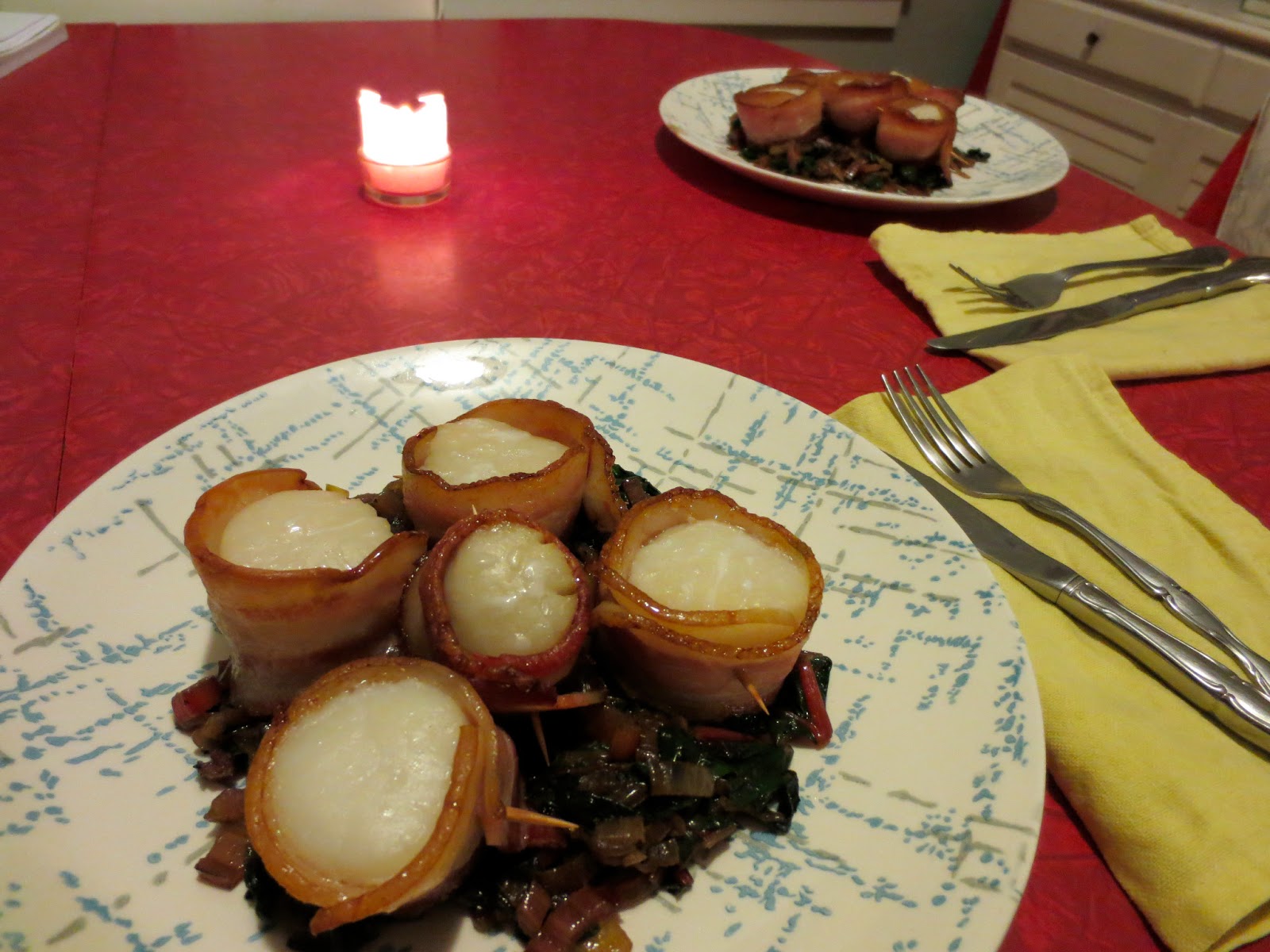
Bacon wrapped Scallops with Swiss Chard

All the snow seems to have inspired a sense of indulgence for me this weekend (though really, I am always on the lookout for an opportunity for indulgence). In this case, it was about some more expensive food items (scallops, pork butt, and bacon), and also some nice outings and overall sense of leisure and expansive snowy weekend time.

I did some reading, snow-shoeing (thanks to some borrowed snow shoes that I am behind in returning), and went to a really lovely, very snowy film, Happy People by Werner Herzog. The film is a documentary about a small town in Siberia that is accessible only by helicopter or boat (only when the water is not iced over). The town's people are fairly cut off from modern invention - they use snow machines and chain saws, but most everything else they make. The craftsmanship is really amazing, and the images throughout the whole film are stunning (you see many of them in the preview linked above.) It is showing at the newly refurbished Uptown Theatre - which now has very spacious, leather seating and even a bar and sofas on the 2nd floor!?

The weekend started out Friday evening with a dinner of Bacon wrapped Scallops and some Swiss Chard. I love scallops, and the slightly tart greens were a nice complement to the sweetness of the scallops and bacon. After some trial and error, My Charming Companion and I determined that 5 large scallops each is a preferred amount. Ten scallops came out to about 8/10 of a pound, so you can figure accordingly how many scallops you might prefer (remember there is a lot of bacon involved too!)


See upper right scallops for how NOT to wrap bacon!
Scallops
10 large wild scallops
10 slices of bacon (you will trim off part of each slice, which makes leftovers for breakfast!)
fresh lemon
10 toothpicks

Preheat the oven to 400 degrees. Wrap each scallop in the bacon, making sure to overlap the bacon just enough to secure with a toothpick. Trim off excess bacon (optional) and save for tomorrow's breakfast. Place scallops in a cake pan and bake for 20-25 minutes, until bacon is crispy. While scallops are cooking, make chard recipe below.

Swiss Chard
1 large bunch swiss chard
1/2 onion, sliced thin
2 T ghee, butter, coconut oil, or bacon fat
splash vinegar (I used champagne vinegar, but apple cider would be good too)
salt to taste

Heat fat in a large skillet. Add onions and saute for a few minutes. Trim chard leaves chard from the ribs, and chop the ribs in small pieces. Add chopped chard ribs to onion and saute for another 5+ minutes, stirring occasionally until onions are translucent. Add chopped chard greens and saute for another 10 minutes. Season with a splash of vinegar and salt to taste.

Serve scallops over or alongside chard.

AND THEN....don't abandon the really delicious bacon fat and scallop juice from the pan! It is delicious the next morning with scrambled eggs. They taste scallop-y and soft and amazing and I could not wait to make breakfast.

Just stick the juice filled pan in the fridge overnight. In the morning, stick the pan in the oven at 350 degrees for a few minutes to heat up. Stir up some eggs with a bit of salt, and then pour them into the heated cake pan. Bake in the oven for 10 minutes or so, stirring every few minutes. I chopped a bunch of parsley to add in to the eggs, and made a saute of onions and peppers with the leftover bacon ends to go with. Yum!

2.20.2013

Kimchi Jjigae take 2

I have made Kimchi Jjigae 3 or 4 times since I posted the original recipe in November. I am almost out of my big kimchi batch from last summer, so it appears that I will never get to year old kimchi (which would be best in this recipe) - at least not until next year when I will have to make a really big batch. Since my original post, I have switched over from using nori seaweed as a garnish and instead just put in a bunch of wakame. The wakame is delicious! I want to try making a salad out of it sometime - maybe when there are more fresh veggies around. It is a pretty mild seaweed with a silky texture. I bought mine from United Noodle in a 5 oz bag that I think will last a year because one handful = a lot of seaweed once you hydrate it in water.

It tastes amazing in the kimchi jjigae - it sort of mellows the sour from the kimchi. I love to slurp this soup up on the weekend - I don't know if it is all the bacon, or what, but it's sort of delectable and weekend-ish. I have modified this recipe a bit from the original to include the wakame, and I also added in some broth to make a slightly thinner soup. I recently discovered that the Wedge carries Red Boat fish sauce, which is GF and is made only from fermented anchovies with no other added stuff. It is REALLY good, and I put that in the soup too.

Kimchi Jjiage with wakame (serves 6)
Large handful dried wakame
2 tablespoons toasted sesame oil
1 pound bacon, cut into 1/4" pieces
Freshly ground black pepper
Medium yellow onion, coarsely chopped
3-4 cups coarsely chopped kimchi with its liquid (use the most pungent, sour kimchi you have)
1 T Red Boat fish sauce
5 scallions, thinly sliced (opt)
2 c. chicken broth (opt)

Put large handful of wakame in a bowl and cover with water to soak.

Heat the sesame oil in a large soup pot over medium heat. Add the pork belly/bacon, season with pepper, and cook, stirring now and then, until rendered, browned, and crispy, about 10 minutes.

Add the onion and kimchi and stir to combine. Add enough water to nearly cover the pork mixture (5 or 6 cups), cover, and bring to a boil. Immediately reduce the heat and simmer until the onion and kimchi are softened and the soup is quite thick, about 20 minutes.

Stir in the fish sauce, broth and scallions. Drain the wakame, chop it up and add to the soup. Cover the pot and simmer for 10 minutes to combine the flavors. Serve steaming hot.