We are a collection of Minneapolis folks cooking, preserving, and harvesting local, seasonal foods. This blog-share is meant to inspire greater culinary genius, as well as continued local food invention. What are YOU concocting in that kitchen of yours?
Showing posts with label beef. Show all posts

4.19.2021

Quanta Fir Fir (and Majet)

In honor of my birthday, my podmate and I decided to make Majet, a tower of 4 dishes that is served at Bolé restaurant. After postponing the dinner once, we finally made it happen last weekend. And, wow. I kind of can't believe we made something SO delicious and magical. I told another friend about it who commented, it's like you had meat cake! Which is kind of true. Majet is totally like meat cake.

I ate way too much because I couldn't help it, it was so good. After dinner I proceeded to be fairly horizontal for the rest of the evening - which was pretty perfect. We watched the new episodes of Top Chef and smoked hookah and it felt like I was on a weekend vacation with 5 star dining.

Majet is Bolé's creation, and is basically layers of quanta fir fir, beef tibs, kitfo, and gomen, with Ayb (a dry, fresh Ethiopian cottage cheese) and injera. It is a vision to behold, and would be quite stunning to serve for a group. Someday, this will happen. 

I somehow have neglected to post the recipe for kitfo previously, so that is still on the agenda, though the new recipe to me of this undertaking was the quanta fir fir, using the quanta (Ethiopian beef jerky) I made a couple of months ago. Quanta fir fir is commonly served as breakfast - with the dried injera it's almost porridge like, and the base of it (a berbere spiced sauce of tomato/onion) is a dish you could also eat on its own. I used some leftovers to make quanta fir fir with eggs, and it's kind of like an Ethiopian version of chilaquiles using dried injera (called derkosh) instead of corn tortilla chips. *To make derkosh, you just need to dry any leftover injera in the oven at a low temp. It shrinks a bit and becomes crisp. You can also buy it from Ethiopian grocers.

The Quanta Fir Fir is the orange layer on the top!


We made a large batch, which made for MANY meals. I am halving what we made below. My friend is not a measurer, so I estimated as best I could. We chopped everything in the food processor because we were prepping items for this dish and for the gomen too. I'm guessing this amount would serve 4?! Really hard for me to tell.

  • 4-5 garlic cloves, minced
  • 1" piece of ginger, minced
  • 2 red onions, diced small
  • 4-5 tomatoes (med), diced small
  • 3 T berbere
  • sea salt to taste
  • 1 tsp pepper
  • 1 chicken bouillon cube
  • 1/4 - 1/3c avocado oil
  • 1c quanta, torn into bite size pieces 
  • 1 tsp black cardamom
  • 1-2 T Ethiopian spiced butter (or ghee)
  • 1-2 c dried injera (called derkosh)
  1. To a dry pan, heat onions over medium heat. They will release their liquid and start to become thick, almost gelatinous. 
  2. Add 2/3 of the garlic/ginger, leaving the rest to add at the end. Also add spices, bouillon, and 1/4c avocado oil. *You will likely add some more oil as you cook, looking for a thick, almost gelatinous texture, and so the onions and spices do not stick to the bottom of the pan. The berbere will make the dish very red. 
  3. Once you've sauteed the added ingredients in the oil (several minutes), add a little water and the tomatoes. The mix will be quite soupy. Turn the heat to med-low, cover and simmer. It will get thicker. (This dish can be served on its own here, it is really delicious as is.)
    Berbere sauce on left, gomen on the right
  4. After the sauce simmers for 5 minutes or more, it will be a bit thicker (see photo above). Add the quanta, black cardamom, and butter/ghee. Stir and simmer another few minutes to hydrate the jerky. Finally, add the derkosh. Gently stir while it hydrates, several minutes. The saucy mix will now become quite thick, almost like a porridge of injera. It is now ready to serve!


For the Majet, we started with a layer of injera, 2 pieces layered on top of one another, rolled up on the sides to create an edge. We then layered our beef tibs, and then the quanta fir fir. On top of that went the gomen, followed by kitfo, and finally the ayb. Plus kitfo in the corners with tibs in between to fill the platter and touches of more ayb for aesthetic viewing.

 So spectacular!!!

3.10.2021

Basturma (Armenian Charcuterie)

I've cured salmon for gravlax before, but so far had not tried any other meat curing endeavors. Til this basturma! It turned out great - especially when I am able to slice the meat super thinly (think proscuitto). When I don't, it is a little chewy, but still really lovely in flavor and texture. I like the spice mix decently, and I feel curious to play around a little. My research shows that basturma is popular in the middle east and the mediterranean, as well as Armenia/Turkey/Russia. And that it is good on its own, or to fry a few slices with eggs for breakfast (really good). Yum.

I have had my eye on this Armenian cured meat recipe all winter, and so finally on my recent quarterly farm delivery I ordered a 4 pound eye of round roast. The Saveur recipe and step by step instructions were very useful, to which I add just one main modification: to not take the meat down from its hanging place to slather on the seasoning mix, and instead apply it while hanging - WAY easier! The Saveur link goes into detail about spices and meat cuts (best to get fresh spices if you can, use a lean cut). *I did order fancy blue fenugreek from Georgia, which was not cheap, at about $10 for just under 2 oz, which was right about half a cup.

This was really fun to make - fairly easy, but I had to put reminders on my calendar. And it was an interesting experience to determine when I thought the meat was "ripe-avocado-feeling." There is a bit of range for that particular texture, even though I find it a pretty good descriptor. I called that stage done at 12 days, and my basement probably ranged from 45-60 degree (that is my guess anyway, I don't have a thermometer down there).

My favorite part was the spreading of the spice mixture, again, way better to do while hanging. I did not do that initially, and then you have to stand the meat on end, and lay it down, and each time you do, it gets marred and some spice mix clumps off. Whereas when it is hanging you can smooth it out with no interference. The spice consistency (Benjamin Kemper of Saveur called it "thick pancake batter") holds its shape pretty well and is really satisfying - kind of like thick buttercream that you spread with your fingers. It will make your basement smell like fenugreek and paprika. 

Basturma Recipe

Yield: makes 3 lbs 8 oz
Time: 11-18 days, depending on the temperature

For the meat:

  • 4 lb. eye of round beef roast
  • 1 lb. kosher salt

For the seasoning:

  • 12 cup ground fenugreek (preferably blue fenugreek)
  • 12 cup sweet paprika
  • 1 tbsp. ground allspice
  • 1 tbsp. freshly ground black pepper
  • 2 tsp. cayenne pepper
  • 2 tsp. ground cumin
  • 1 tsp. kosher salt
  • 8 large garlic cloves

Instructions

Part 1: Cure the Meat (3 Days)
  1. Cut the eye of round roast in half crosswise (against the grain) so that it is easier to handle. Each piece should be about 2 inches thick. Using a skewer, poke the pieces all over so that the salt can penetrate the meat. Spread a thick layer of salt in a 9- by 13-inch roasting pan and place the meat on top. Coat all sides of both pieces with more salt so that the meat is barely visible. Cover and refrigerate for 2 days. (After 2 days, the salt will have drawn out a lot of liquid from the meat.) 
  2. Fill a large bowl with cold water. Drain the meat and rinse off the salt. Submerge the meat in the cold water for at least 1 hour or up to 3 hours. (This will draw out any excess salt.)
  3. Remove the meat from the water and thoroughly dry each piece with paper towels, pressing down to remove as much moisture as possible. Wrap the meat completely in dry paper towels and place on a large, rimmed baking sheet. Place a second large baking sheet on top of the meat, then weigh down the top pan with a few 28-oz. cans of tomatoes or something similar in weight. Refrigerate at least 8 hours or overnight
Part 2: Hang the Meat (5-10 Days)
  1. Find a place to hang the meat as it cures, preferably in a clean room that never exceeds 70°F, with some airflow. Next, uncover the meat and remove and discard the paper towels. The beef should be flat and slightly firm to the touch. With a skewer, pierce each piece about 1 inch from one end. Tie a piece of butcher’s twine in a knot on one end of the skewer and, leaving the other end of the twine long enough to hang the meat from the desired spot, thread it through the hole in the first piece of beef. Repeat with a second length of twine and the other piece of beef. Hang the meat up by the string and allow it to air-dry for 5–10 days, or until the pieces of beef feel as firm as a nearly-ripe avocado. (Alternatively, hang the meat in the refrigerator for 8 to 14 days. You may place a rimmed baking sheet underneath, though the meat should be dry from the cure and no longer dripping.)
Part 3: Add the Chemen Seasoning Mix (3-5 Days)
  1. Take the meat down, leaving the string in place, and transfer it to a large, clean baking sheet. Set aside.
  2. In a medium bowl, mix together the fenugreek, paprika, allspice, black pepper, cayenne, cumin, and salt. In a small food processor, puree the garlic with ½ cup cold water. Add the garlic puree to the bowl of spices and mix thoroughly. Pour in an additional ½ cup cold water, or more as needed, until the mixture resembles thick pancake batter. Smear the spice mixture all over the meat in a thin (about ⅛ of an inch), even layer. Rehang the meat for 2–3 more days (3–5 days in the fridge), or until the spice mixture is firm and dry to the touch. At this point, the basturma is ready to eat. To serve, slice as thinly as possible against the grain with a sharp knife. Store the basturma wrapped tightly in plastic wrap in the refrigerator for up to 3 months.

2.15.2021

Ethiopian Beef Jerkey (Quanta)

I bought myself a food dehydrator this winter and have used it for a handful of things, one of which was a prime reason for making the purchase: jerky. Which, having previously made jerky only from venison, I have to admit that trimming the fat from beef, even from lean cuts, is so much more tedious! I also have yet to develop a good method for making some longer nice thin cuts of the beef - at least the way my eye of round roast was butchered, which I found less than ideal. But I will withhold final judgement until I've tried other cuts. Also, I realized after dehydrating that I could have cut the beef a bit thicker - good to know!

Quanta firfir is a very popular Ethiopian dish using dried meat (jerky) and dried injera. I've had it before, but have not made it at home. So while my primary interest in making jerky is as canoe trip travel food, a secondary interest is to make quanta firfir. At some future date, when I will have some tutorial. (Which, I just realized would also make a good canoe trip meal because it uses all dried ingredients! Huzzah!) I did embark on making this jerky independent of my Ethiopian friend because I was able to watch a youtube video in Amharic where the ingredients were typed out in English. Friends, this turned out amazing! I love these spices - the spiciness of the mitmita totally kicks this jerky out of the park.

The spices mixed in with the beef made me so hungry for kitfo (I admit I sampled some raw jerky morsels b/c I couldn't resist). You will need Ethiopian spices if you make this - there just will not be a proper substitute. 

Ingredients:

  • 4 pounds of lean beef (eye of round, flank, etc), trimmed of all fat, cut thinly
  • 2 tsp Berbere
  • 5 T Mitmita
  • 2 T salt 
  • 2 1/2 tsp Korerema (false cardamom, ground)
  • 1 1/2 tsp black pepper

Mix all spices together in a small bowl. 

Add spice mix, a little at a time, to the sliced beef. Mix very thoroughly and well with your (gloved) hands. Your goal is to cover all the meat surface with some spice mix. This will take some time. Once the beef is covered, let it marinate in the fridge for 6-12 hours.

To dry: lay in a single layer on your dehydrator racks, making sure that no meat is overlapping. Dry at 145 degrees for 4-10 hours, depending on the thickness of your jerky. (Because I cut mine so thin, it was done after 6 hours. I could have pulled several pieces after 4, but instead have some very thin extra crispy bits.) 

You know your jerky is done when there is no squish to the meat, and the jerky is pliable and leathery. If they break when you bend them, they are overly dry. You want them to bend and crack, but not break when cool (much like a green stick from the forest).

1.06.2021

Braised Short Ribs

I bought short ribs on my last farm order because they were buy one get one free, though I have never prepared this cut of beef before. I am assisting for another training all weekend, so decided to make this dish to heat up and eat with less cooking fuss. They are quite fatty, which I generally appreciate, but I wonder if these particular ribs have a bit...extra? In any case, they were tasty in the way of a stew, where the meat falls from the bone into a really rich sauce/broth. I really do enjoy cooking meat on the bone in this unctuous manner. I ate mine over some mashed root veggies (rutabega/turnip/daikon blend) and it was delicious. The original recipe serves it over polenta (or go with grits, or my keto grits, aka porridge).

I modified this recipe slightly, less wine, no shallots, I used arrowroot in place of flour (though I think you could skip that step all together), added garlic, and used bacon instead of pancetta. I did brown my ribs on all sides, which is a bit fussy. I think you could skip this if you want to save time and you would not sacrifice flavor.

Ingredients

  • 4 pounds beef short ribs, cut into pieces
  • 3 slices bacon, chopped fine
  • Salt and pepper
  • 1/2 c arrowroot starch or GF flour
  • 2 small onions, diced
  • 3 carrots, diced
  • 3 cloves garlic, minced
  • 1 c red wine
  • 2 c beef broth
  • 2 sprigs fresh thyme
  • 2 sprigs fresh rosemary
  1. Salt and pepper ribs, then dredge in arrowroot/gf flour if using. Set aside.
  2. In a large dutch oven, cook bacon over medium heat until complete crispy and all fat is rendered. Remove bacon and set aside.
  3. Raise heat to high. Brown ribs on all sides, about 45 seconds per side in the rendered bacon fat. Remove ribs and set aside. Turn heat to medium.
  4. Add onions and carrots to pan and cook for 2 minutes. Pour in wine and scrape bottom of pan to release all the flavorful bits of glory. Bring to a boil and cook 2 minutes. 
  5. Add broth, 1 teaspoon kosher salt, and plenty of freshly ground black pepper. Taste and add more salt if needed. Add ribs to the liquid; they should be almost completely submerged. Add thyme and rosemary sprigs (whole) to the liquid. 
  6. Put on the lid and place into the oven. Cook at 350 for 2 hours, then reduce heat to 325 and cook for an additional 30 to 45 minutes. Ribs should be fork-tender and falling off the bone. Remove pan from oven and allow to sit for at least 20 minutes, lid on, before serving. At the last minute, skim fat off the top of the liquid. (Can also refrigerate mixture, then remove solid fat from the top.)
  7. Serve 2 ribs on bed of mashed root veggies, or creamy polenta or grits, spooning a little juice over the top.

12.21.2020

Gochujang meatballs and Korean potato pancakes

I am a fan of meatballs. They are easy, they are cheap, and they make good leftovers. So I was excited when I came across a Korean style-meatball recipe, primarily meaning the recipe includes gochujang (Korean chili paste), which I had never had before. In the interest of minimizing shopping trips, I checked the co-op when I was there last for gochujang, which they had and I bought. United Noodle would have many more options! I did not read the label until after I made the meatballs, upon which I saw that there is wheat flour in this particular version. I ate some meatballs anyways, and so far am not having gluten intolerant reactions. (I looked up gochujang paste ingredients, which were mostly in Korean, and seem to often include barley, sometimes wheat. So. One could make their own gochujang, at least a modified version of it, if you want gluten allergen certainty.)

I thought the meatballs turned out great - they were more moist than my usual meatballs, which made me wonder if I often overcook them, or if this particular combo of an egg and half cup of almond flour really made the difference. The original recipe from Food52 also included a gochijang/apricot glaze that I did not make, and is probably delicious, because adding a little more sweet usually is! Instead I ate the meatballs with kimchi, which was really nice.

I decided to also try making korean potato pancakes, though I used my veggie julienner rather than a grater (because I only have a very tiny or extra large grater), and I did a combo of rutabega, potato, and a carrot instead of all potato. And added coconut flour and an egg. So. It's maybe more accurate to say korean-inspired potato (and more) pancake. I did add some green onion, and made a sauce with tamari and rice wine vinegar, which is the thing that distinguishes them from my latkes. They were delicious - I mean, you can't go wrong, ever really, with fried potato/root veggie pancake things. (The sauce was also good with the meatballs.)

Gochujang Meatballs, serves 2-4

  • 2 green onions, very thinly sliced
  • 2 garlic cloves, minced
  • 1 egg, lightly beaten
  • 1 pound ground beef
  • 1/2 cup almond flour
  • 2 tablespoons gochujang (Korean chili paste)
  • 2 tsp ground ginger
  • 1 teaspoon kosher salt
  • 1/2 teaspoon ground pepper

Preheat oven to 350. Combine all of the ingredients well. Form into 1" balls and place on a cookie sheet. Bake for 12-15 minutes. I put mine under the broiler for the last few minutes to brown the tops. Serve with kimchi! (Or see original recipe linked above for apricot glaze if you want to eat more appetizer style.)

Gamjajeon-inspired Potato Pancakes, serves 2

  • 1 medium red or yellow potato, shredded
  • 1+ c shredded rutabega
  • 1 shredded carrot
  • 1/4 small onion, minced
  • 1 tsp salt (or more to taste)
  • 1 egg
  • 1 T coconut flour 
  • oil for frying (I used coconut oil)

Combine all ingredients. Mixture should be moistened, but still fairly dry. Heat oil in a skillet on med-high heat. Pile handful or large spoonful of veggie mix in pan and flatten. Fry 4-5 minutes on each side, until crisp and browned. Set aside and continue frying until all "batter" is used.

Make a dipping sauce of:

  • 1 T tamari
  • 1 tsp rice vinegar
  • 1/2 tsp honey or sweetener of choice
  • 1/2 tsp pepper
  • 1 tsp water

*I ate leftover meatballs with Okonomiyaki the next night (this time it was just cabbage, carrots and green onion - no nettles), with the sauce listed there and some mayo. Also very good. I also thought about using meatballs in egg foo young...maybe that is what will happen to the last few!

11.17.2020

Kofta

I made a stunning dinner plate last night - it was so beautiful that it felt a shame to be eating it alone! Which is funny because it was largely comprised of leftovers, and also funny because I made and ate it during my one hour dinner break before finishing the day with evening clients. I think I find it so stunning for all the bright colors and the variety, hence the value of leftovers here.

This plate! I was not, for the COVID record, feeling bereft of companionship on this particular day, having spent the weekend with a bevy of beloved people in what turned out to be a rather profound experience of secure attachment, which may also have assisted with the beauty-making here. May we all find nourishment these days, in the multitude of forms that can take, whether we be eating alone or with others. (And may we all get to experience secure attachment. Holy smokes. So much support! Who of us got this? We are all wandering around doing our best, not ever really experiencing the support we needed. Our parents or grandparents either, clearly. I mean, I knew this before, but to actually feel what it is like to have secure guidance and group leadership?! It changes everything.)

So - My dinner plate. The main feature is the kofta, nestled in tahini sauce, accompanied by (leftover) roasted beets and squash with roasted spices. The latter really upped the meal caliber, along with the remains of a simple kale salad. I added a few pickled green tomatoes, some greek yogurt with dried mint, and I roasted a small tomato because one was ripe and red on the counter. :)

If you want to accompany your kofta with some roasted veggies, the highlight of these was that I added some whole cumin and whole coriander when I reheated them in the oven. The toasted spices, plus some dried mint, salt, and fresh ground pepper on top achieved peak deliciousness. Especially dipped in the tahini or the yogurt. 

For the kofta: I did not have parsley, so omitted that and they were still delicious. I include parsley in the recipe below, which is from the cookbook Jerusalem. My version below is modified for just 1 pound of beef (instead of their recipe for half lamb half veal/beef to total 28 ounces), but otherwise sticks to their recipe.

Kofta - serves 3

  • 1 pound ground beef (or lamb)
  • 1/2 small onion, finely chopped
  • 1 clove garlic, minced/crushed
  • 3 T toasted pine nuts (I used walnuts and pecans), chopped
  • 1/4 c parsley, finely chopped
  • 1 jalapeno, finely chopped
  • 3/4 tsp cinnamon
  • 3/4 tsp allspice
  • 1/4 tsp nutmeg
  • 3/4 tsp black pepper
  • 1 tsp salt

Place all ingredients in a bowl and use your hands to mix everything together well. Shape into torpedo like fingers, about 3 inches long (mine were a bit more squat). Press the mix and compress to ensure each kofta is tight and keeps its shape. Arrange on a plate and chill until ready to cook, up to 1 day.

Preheat oven to 425 degrees and make tahini sauce (recipe follows). Heat 1-2 T avocado or olive oil in a cast iron skillet and sear the kofta, making sure they are not cramped in the pan. Sear them on all sides until brown, about 6 minutes total.  Place in the oven for 2-5 minutes if you want them medium or well done (they will be somewhat rare after the searing). 

Tahini sauce:

  • 1/3 c tahini
  • 2 T fresh squeezed lemon juice
  • 1 T olive oil
  • salt
  • 1-2 T water
  • opt garnish: melted butter, finely chopped parsley, toasted pine nuts, sweet paprika

Mix all ingredients together until smooth. Use enough water to make the consistency a bit runnier than honey. 

To serve: Spoon your tahini sauce onto a plate or serving dish, and lay each kofta on top. If you use butter for the kofta, spoon it over each kofta piece right out of the oven (this is extra tasty!), and top with any garnish. Serve immediately. 

10.20.2020

Beef Stew - Keto

There are so many beef stew recipes, at least a few on this blog alone. This NomNomPaleo one is lower carb & keto - no potatoes and limited carrots, and includes a good number of mushrooms. It was delicious, aided by the fact of cooking it on a wood stove amidst snow flurries up north after having hiked some miles. What would not be delicious under such circumstances?! I love something cooking on the woodstove, wafting up the house with good smells, especially after a walk or ski or whatever, requiring no other heat or energy source than what is already happening.

Here is a photo of an all important protective orange hat ("I am not a grouse!") with me underneath it. (The hunters I talked with were empty-handed. The grouse, presumably, were staying put with the snow.) This stew was SO good - lots of umami - the cremini mushrooms were a perfect texture/flavor addition, the turnips were creamy, and the meat melted in my mouth. I had two big bowls, where the broth was nice and shimmery with the fat. It was so satisfying.

This recipe is also easy. I didn't brown the meat, I didn't chop up tomatoes, or use wine. I followed the NomNomPaleo recipe, but she makes hers in an InstaPot. I used some broth in mine to compensate for the longer cooking time and need for more liquid; I also added some apple cider vinegar. With weather like today in Minneapolis (5 or 6 inches of snow!), this stew is all I want. 

*Note part of why I think this was so good is that I did use Michelle Tam's magic mushroom powder (that I also use on chicken). I highly recommend it - it adds an extra boost of mushroomy/umami goodness. 

Ingredients: serves 6-8

  • 3 pounds beef chuck roast, boneless short ribs, or beef brisket cut into 1½- to 2-inch cubes
  • Kosher salt or Magic Mushroom Powder
  • 1 tablespoon ghee, avocado oil, or fat of choice
  • 2 medium onions, thinly sliced
  • 1 pound cremini mushrooms, cleaned, stemmed, and quartered
  • 2 tablespoons tomato paste
  • 6 garlic cloves, peeled and smashed
  • 2 tablespoons tamari
  • 1 teaspoon (Red Boat) Fish Sauce (I did a long pour on this tsp!)
  • 2 tablespoons apple cider vinegar
  • 2 fresh thyme sprigs
  • 1 dried bay leaf
  • freshly ground black pepper
  • 2 c beef/venison bone broth
  • 2 turnips, diced (or daikon radish/sunchokes/any combo)
  • 2 large carrots, diced
  • ¼ cup Italian parsley, roughly chopped for serving

1. Toss beef cubes in salt (or magic mushroom powder) and set aside. 

2. Melt ghee/fat in a dutch oven or large pot. Add onions, and saute until soft, about 5 minutes. Add mushrooms and saute another 5 minutes. Stir in tomato paste and garlic, cook for several more minutes.

3. Add to the pot: the salted beef, tamari, fish sauce, apple cider vinegar, thyme, bay leaf, pepper, and bone broth. Bring to a boil, then set the heat to low and let simmer 2-3 hours, until beef is tender. You could also put it in a slow cooker, or move your pot to the wood stove, if you have one. 

4. 30 or so minutes before serving, add diced turnips and carrots to the stew. Continue simmering until they are soft. Taste for salt, and add more (or magic mushroom powder) until delicious. Ladle heaping chunks of meat and veggies into bowls, with just enough broth to sip at the end. Top with chopped parsley. Or sauerkraut. Or eat as is. 


8.29.2020

Meat Stuffed Eggplant (Garni Yarikh)

This is another Bottom of the Pot recipe. It was perfect comfort food to me on this cooler, summer day. I have been attending a virtual training about complex trauma the past several days, specifically around narcissism and how it underlies all of the destructive things we do: loving the image we have of ourselves, and hating what is really there. It is a bit, um, intense. So comfort food seems pretty nice! 

*Also nice was my walk yesterday evening in the warm wind just after sunset, passing two little girls in hijabs singing out really loudly towards the lake as they trailed behind their dad. They were singing a song from Moana, which I watched a month or two ago and loved, about the light on the sea being blinding and calling them. I found the whole scene such a delight.

I love roasted eggplant, and this recipe really takes it to a whole new level. Author Naz Deravian says that Garni Yarikh is Turkish for "split belly," referring to the eggplant. Her words about this dish are more enticing than any I could come up with: "This is the kind of dish that seduces and beckons as silky eggplant collapses into well-browned and delicately spiced meat, all simmering over a rich tomato-based sauce." I was won over by Naz (meaning to buy her cookbook) after hearing her read her mom's poetry and witnessing her emotion about it. Persians and poetry, man. Talk about seduce and beckon!

For this recipe, I also got to use all garden produce except the onion. My garlic is now officially cured, and I selected some nice big bulbs for this recipe. This year, I grew a few different varieties of eggplant, and harvested several of these thinner long ones in the last week or so, which are ideal for this recipe. I also have a handful of palm sized ones, and I was a little short, so I used one of those too. 

Incidentally, while doing my garden plot rotation of refilling the water barrels last week, I saw that someone is growing okra. I have never seen okra grow before, and I found it so stunning I had to go back and look at it again. Next year: Okra!

Split eggplant, oiled and ready to roast

Serves 4-6

  • 6 Italian or baby eggplants (about 2 pounds)
  • 1/2 C olive oil, divided
  • 10 cloves garlic, thinly sliced
  • 1 yellow onion, finely diced
  • kosher salt
  • 1 pound ground beef
  • 6 T tomato paste
  • 1/2 tsp cinnamon
  • 1/4 tsp allspice
  • 1/8 tsp ground cloves
  • ground black pepper
  • 1/2 bunch parsley, tough stems trimmed, chopped
  • 1/2 c cherry tomatoes, sliced in half

Preheat oven to 425 degrees.

Peel the eggplant in stripes, with the stem and cap on. Leaving 1" on the top and bottom, cut a shallow split lengthwise in the belly of the eggplant, without piercing through, stopping about 1" from the bottom. Place the eggplant in a large bowl and drizzle a little olive oil in each slit, and sprinkle generously with salt. Rub olive oil all over the rest of the eggplant, and season with a good pinch of salt and pepper. Place the eggplant on a baking sheet and bake for 35 minutes, until fork-tender. Set aside to cool.

While the eggplant roasts, prepare the filling. Bring a kettle of water to a boil and keep it at a simmer. In a large pan, heat 1/4 cup olive oil over med-low heat. Add the garlic and cook very gently, constantly stirring until slightly softened, but taking care it doesn't take on any color, about 5 minutes. Transfer the garlic to a small bowl and set aside. Using the garlicky oil in the pan, turn the heat up to medium and add the onions. Cook until softened, about 8 minutes. Sprinkle with a little salt, turn up to med high, add the meat, and brown for 5 minutes. Stir in the tomato paste and cook with the meat for 2 minutes. Reduce the heat to medium and add the spices plus 1 tsp salt and 1/2 tsp pepper. Give a stir and add 1/2 c water from the kettle. Reduce the heat to med-low and cook until the meat is cooked through and all the flavors come to life, about 5 minutes.Taste and make delicious. Remove from heat and stir in the garlic and parsley.

Eggplant boats
With a fork, gently push the eggplant flesh to either side, making room for the filling, and sprinkle with a little more salt. Fill each eggplant with about 2 T of the filling, depending on the eggplant size. You will have filling left over in the pan. Place the pan back on the stove over med heat, add the cherry tomatoes and 1/2 cup more water from the kettle. Give a stir, and bring to a good simmer. Taste and add more salt or spices as needed. Gently nestle the eggplant boats in the sauce, spoon a little sauce over the eggplant, cover, and reduce heat to low. Cook until the tomatoes collapse and release their juices, and the eggplant is completely tender and everything is luscious, 35-45 minutes. Garnish with parlsey and serve.

Post simmering, eggplants all nestled in with the sauce.

4.15.2020

Ethiopian Beef Tibs

Well, this is a dish I've been meaning to post for awhile, though I did not have injera to eat with it. Next time I make these I might take myself on the adventure to procure some all-teff injera from Shega Foods.

I went to a new Ethiopian place that opened near my house several months ago intending to order kitfo and kocho, neglecting to notice they only serve that on weekends. So, without injera (they had only the glutinous kind), I opted to get their beef tibs, assuming they would certainly be good, using salad as the injera-vessel. Friends, they were not good. They were swimming in oil and were bland and not caramelized and it was disappointing. I am spoiled by Bolé. I guess I thought all tibs were crispy and chewy and delicious. Not so. (Incidentally, Bolé's link has a youtube video where they are making their Derek Tibs. You can see the goodness! They also show their signature dish Majet, which is a beautiful tower of Derek Tibs, Kitfo, and Quanta Firfir that I highly recommend with the all teff injera.)

Previously made tibs with shiro and avocado salad atop injera
I learned to make these tibs from my friend who grew up in Ethiopia. It took about 6 times for me to finally get it, thanks to her standing by and saying, well, are you going to make the tibs or what? So I would quit waiting for her to tell me what to do. 😂  (I am still in that phase with the creamy chickpea dish shiro, which means I have to make it another time or two with her nearby before I post that one, which is nice to eat alongside.) She and I have used various cuts of meat for this dish, and the favorite is a thinly sliced top round steak. The meat is diced into pretty small pieces, so you can also use skirt steak, flank steak, a flat iron, etc and just trim any fat.

Beef Tibs serves 2-4
1+ lb lean steak, cut into 1/2" square pieces
1/2 large onion, sliced thin
2 T Ethiopian cardamom*
1/4 tsp mitmita (or more, it's spicy)
1 jalapeno, diced
2 cloves garlic
sprigs of rosemary (opt)
*Ethiopian cardamom is more coarsely ground, and is also called "false cardamom" or "Korarima." It is a black cardamom from the ginger family, not the smaller green pods of Indian cardamom. You can buy it at Shega Foods, along with mitmita spice mix, and Niter Kibbeh (if you don't want to make it). (If you do not have Ethiopian false cardamom, use regular cardamom and add a touch of nutmeg, cloves, and black pepper.)

1. Heat a large cast iron skillet on high heat. Add your meat to the skillet (no oil/fat is added yet, so you are cooking the meat dry). Cook off all of the meat juices until the meat starts to brown, 6-12 minutes depending on your meat.
2. Add your onion slices, also dry, to the meat. Cook until the onions release their juices and also begin to brown, several minutes.
3. Lower the heat and add the niter kibbeh, cardamom and mitmita, being sure to coat all of the meat pieces with the butter and spices. Add the garlic, jalapeno, and rosemary. Cook, stirring occasionally, for 10 minutes. Salt to taste. Serve!

The bite size pieces are perfect for eating with injera and with your hands. This time I ate them (non-traditionally) with some roasted beets, cabbage, and some left over rice.

3.25.2020

Shepherd's Pie (paleo)

I have made shepherd's pie before - I just checked, and I posted a recipe in 2012. Maybe this one is similar?! Global pandemics call for comfort food, which for me today is mashed cauliflower baked on top of meat and veggies. Is this a casserole? I think so. I made it while sipping on a whiskey ginger and listening to Mehdi Hasan and Jeremy Scahill, who feel like people of great sanity amidst some perplexing (at best) and horrifying (at worst?) responses to the changing world, capitalism, and coronavirus. I also listened to my friend's most recent recording (just released last week) of traditional choral world music, for a respite from politics. Which was very satisfying.

The highlight of this shepherd's pie recipe is the inclusion of mustard in the topping. Yum!!! This is an excellent addition that I will now implement in my mashed cauliflower going forward.

Cauliflower topping
1 large head cauliflower, cut into florets
2 tbsp ghee or butter
1 tsp spicy mustard
Salt and freshly ground black pepper, to taste
Fresh parsley, to garnish

Meat/Veggie mix
1 tbsp coconut oil
1/2 large onion, diced
2 cloves garlic, minced
3 carrots, diced
2 celery stalks, diced
1 lb. lean ground beef
2 tbsp tomato paste
1 cup chicken or beef broth
1 tsp dry mustard
1/4 tsp cinnamon
Salt and freshly ground black pepper, to taste

1. Place a couple inches of water in a large pot. Once the water is boiling, place steamer insert and then cauliflower florets into the pot and cover. Steam for 12-14 minutes, until tender. Drain and return cauliflower to the pot.
2. Add the ghee/butter, mustard, salt, and pepper to the cauliflower. Using an immersion blender or food processor, combine the ingredients until smooth.
3. Meanwhile, heat the coconut oil in a large cast iron skillet over medium heat. Add the onion, celery, and carrots and sauté for 5 minutes. Add in the ground beef and cook until browned.
4. Stir the tomato paste, chicken broth, and remaining spices into the meat mixture. Season to taste with salt and pepper. Simmer until most of the liquid has evaporated, about 8 minutes, stirring occasionally.
5. Spread the pureed cauliflower on top of the meat/veggie mix. Place under the broiler for 5-7 minutes until the top turns golden. Sprinkle with fresh parsley and serve.
(You could also, as the original recipe suggests, transfer everything to ramekins. I did not do this b/c it seemed fussy.)

3.08.2020

Thai Beef Bowl

It's spring! At least for the day. I made a dish that is very similar to my fave end-of-summer dish, Hmong Larb Salad, except this one has (thai) basil rather than cilantro and mint. I loaded my bowl with rice and carrots (using a peeler) and cucumbers (julienne cut), along with the beef mix. It was easy to make, and also perfect on this sunny, 60 degree, late afternoon. I'm getting to the end of my garden carrots, and these cukes are local, hydroponic ones from the co-op.

The original recipe is linked in the title - I changed it only slightly.

Thai Beef Bowl
1 tablespoon coconut oil/ghee
2 shallots, finely chopped
2 cloves garlic, minced
1-inch piece ginger, peeled and grated
2 fresh Thai red chiles, seeds removed and finely chopped
1 pound grass-fed ground beef
2 T tamari
2 teaspoons fish sauce
2 teaspoons lime juice
red pepper flakes, to taste
sea salt, to taste
¼ cup fresh basil, thinly sliced or roughly chopped (Thai basil, preferred)
*carrots/cucumbers/scallions/rice/cauliflower rice/zucchini noodles for serving

1) Heat oil in a large skillet over medium-high heat. Add shallots to the hot pan, stir constantly and cook for 2-3 minutes. Then add the garlic, ginger and red chiles, cook, stirring constantly, until fragrant, about 1 minute.
2) Add ground beef and cook until browned, about 5 minutes, making sure to crumble the beef as it cooks.
3) Add the coconut aminos, fish sauce, lime juice and pepper flakes and stir until well combined, allowing to simmer until it reduces slightly, about 3 minutes.
4) Turn off the heat and stir in the chopped fresh basil.
5) Serve immediately over rice, cauliflower rice or zucchini noodles, fresh carrot, cucumber, and scallions.

2.02.2020

Tangy Stew

I made this stew last week, and pronounced it my favorite stew recipe yet. It isn't all that different from my own made-up, or riffed-on stew recipes, except that it had vinegar in it, and anchovies. And mushrooms, which I don't usually put in stew. And more garlic than usual. I love this stew! I love the tang of it. I guess that is why I have previously liked eating sauerkraut with stew.

I appear to be on a Food 52 kick, because this is the 2nd recipe this week from them, and I've bookmarked a couple more that I want to try. I think I just visited there for inspiration a week or two ago, and achieved that end. I modified their recipe some: I didn't have leeks, used less meat, and added a potato and sunchokes. My anchovy paste, having moved a household over 3 years ago and still hanging out in the butter drawer, expired in 2014. (Maybe it moved two households? From here, to there, and back again?) I used it anyway, and also added a dash of fish sauce in case it had lost some potency. It just seems unlikely that anchovy paste goes bad?! I am not a strict adherent to expiration dates, clearly. It all went alright. I guess I'll buy more anchovy paste to have on hand for the next 6 years.

Tangy Stew serves 8
2-3 pounds beef stewing meat, cut into 2-3 inch pieces
salt and pepper for the beef
1/3 cup olive oil
2 med onions, diced
8 cloves garlic, minced
2 carrots, diced
4 celery ribs, diced
4 ounces white mushrooms, roughly chopped
1/4 cup tomato paste
2 anchovies (or anchovy paste)
1/2 cup red wine vinegar
1 cup red wine
3+ cups beef broth
1 cup canned whole tomatoes with juices
1 large potato, chopped
2-3 sunchokes, chopped (opt)
1 1/2 teaspoons salt
3 bay leaves
3/4 teaspoon dried thyme
1/3 cup chopped parsley

1. Season the beef with salt and pepper on both sides. Brown the meat in batches in a 5-6 quart Dutch oven over high heat, adding more oil as needed. Remove to a plate.
2. Lower the heat and add all the vegetables. Cook for 5-10 minutes until softened. Stir in the tomato paste and anchovies and cook to melt the anchovies and distribute.
3. Add the beef back in, with its juices. Add the wine, vinegar, and tomatoes with juice (breaking them up against the side of the pot as you go) and bring to a boil. Add the stock to cover (you may need a bit more than 3 cups). Put in the salt, bay leaf, thyme, bring to a boil. Simmer, partially covered, for 3 hours until the meat is tender.
4. Mix in half of the parsley and garnish with the rest. Serve!

1.30.2020

Meatloaf - Pork and Beef

This is a really good, very traditional meatloaf recipe from Food 52. I will make it again, as I think it is my favorite meatloaf recipe thus far (I like mushrooms and carrots in there, and all the parsley). I modified it just a little to be GF. This hit the spot for something easy and filling, and cozy for this cloudy bit of weather. I ate it with fried potatoes. Yum.

Meatloaf
olive oil 
2 stalks celery
1 medium carrot
1/2 small onion 
1/2 cup parsley with large stems removed
1 small bell pepper diced
6 mushrooms, with tough part of stems removed
1 pound 80% ground beef
1 pound ground pork
1 cup GF oats
2 large eggs, lightly beaten
spoonful of tomato paste (or a small diced tomato)
2 tsp salt, plus pepper to taste
2 tablespoons heavy cream (optional)
splash of fish sauce (opt, for some umami!)
ketchup to slather on top of loaf

1. Preheat oven to 375° F and lightly oil a rectangular baking dish or loaf pan. Dice celery, carrot, parsley and onion into small bits. Alternatively, process in a food processor until the vegetables are ground.
2. Dice the pepper and mushrooms and sauté them in a small amount of olive oil until the pepper softens.
3. To a large mixing bowl add the meat, ground vegetables, sautéed pepper and mushrooms, oats, egg, tomato paste, salt and pepper, and cream (if using). Mix with your hands until it's all combined. (To check the seasoning, fry off a tiny test patty, taste, and adjust accordingly.)
4. Plop the meat into the oiled baking pan and shape into a loaf. Cover with ketchup. 
5. Bake for 1 hour, remove from oven, and let sit for 15 minutes before slicing. 

12.30.2019

Cardamom Stew

This is one of my favorite meat recipes - it's from a cookbook not belonging to me. The cookbook was photocopied to begin with, and I have a photo of the recipe, so I cannot cite the cook or source. I'm not even quite sure which country this originated - India I think. I remember the author saying that this is a common recipe made for new mothers (sans cayenne). It is delicious with rice, or roasted cauliflower, or sauteed cabbage or greens. The original recipe calls for lamb, which I have used before and like. More often I use beef chuck roast, which is what I used this time. (I didn't get to take a photo. Will do another time and post later!!)

Cardamom Stew
2 1/4 pounds lamb or beef (I prefer off the bone, but you could do either)
1/2 c plain yogurt (I always use coconut milk)
1 T ground cardamom
1/2 c oil (I use less than that of butter, between 1/4 and 1/3 cups)
2 tsp ground black pepper
1 tsp turmeric powder
1 tsp cayenne
2 tsp coriander
3 small tomatoes, finely chopped
salt

1) Mix the cardamom powder with a little water to make a paste.
2) Heat butter in cooking pot; add cardamom paste and pepper. Fry over a low heat 2-3 minutes
3) Add the meat, turmeric, cayenne and coriander and saute for 10 minutes, all the while stirring so that the spices do not burn. *This is important. The recipe author says that this 10 minutes makes the stew, so don't skimp! (I've never tested this, so strong was her admonishment!) It is essential that the heat not be too high and you use enough oil/butter to ensure no burning.
4) Add tomatoes and yogurt/coconut milk and salt. Once it is simmering, lower the heat a bit, cover the pot, and leave to simmer until the meat is tender. I usually go for an hour or two. *The original recipe said to add several cups of water prior to simmering. I have never needed to do this as there is plenty enough liquid from the meat and butter and tomatoes. It would be like soup with all that water, and I always wonder if it was a mistake, or if this is just something I am culturally not understanding about the dish?!

12.10.2019

Beef Chili with Sweet Potatoes

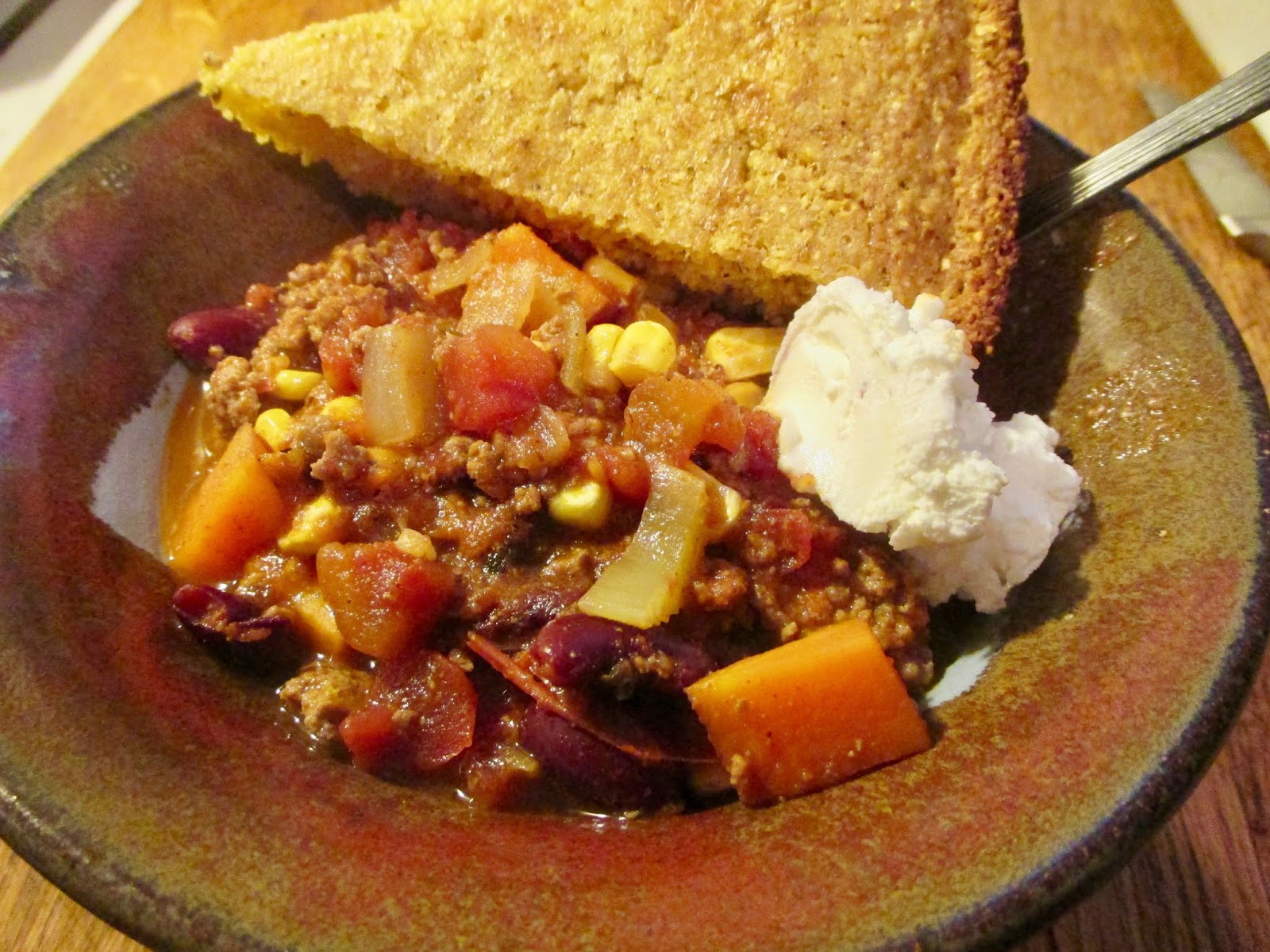
This is my mom's sweet potato chili recipe - it's super easy. She usually makes it with ground turkey, but I most often use beef. I had it this time with cornbread because I still had some kefir from making the skillet cornbread for my cornbread stuffing at Thanksgiving. So why not make it again to enjoy on its own?! (Also leftover labneh which I ate like sour cream on top!)

I'll be out of town for most of the week, and am prepping some meals that I can take with me to reheat. Chili, stew, and salad stuff. Seems easy.

Beef Chili with Sweet Potatoes
2 T butter
1 pound ground beef
1 large or 2 small onions, diced
2 celery ribs, diced
2 garlic cloves, minced
1 jalapeno
1 T chili powder
2 tsp cumin
salt and pepper to taste
2 sweet potatoes (or one large one), diced
1 can kidney beans (or whatever beans)
3 14oz cans of tomatoes (or equivalent frozen garden tomatoes)
1 c frozen sweet corn (or more)

1) Saute onions and celery in butter until soft. Add garlic and jalapeno, and saute another few minutes.
2) Add meat and spices. Cook until meat is cooked through, breaking apart with your spoon.
3) Add tomatoes, kidney beans and sweet potatoes. Cover and cook until sweet potatoes are soft, about 20 minutes.
4) Add corn. Taste for salt, and probably add a little more. Serve!

12.09.2019

Winter Stew

I was craving a good, hearty stew, and found a package of brisket in my freezer. It was quite a fatty piece of brisket (is that always the case? I'm not sure), which I opted to cook with all the fat intact and keep in the stew. It was my first time using my wood stove as a cook top (other than for heating water or to melt butter or toast seeds) - why have I not done this before?? It was so perfect! I set my dutch oven on top and it simmered away all day as if it were a crock pot.


I followed this recipe for root veggie stew, with barely a tweak. I added rosemary because I have an enormous pot of it next to the counter, which means I put rosemary in just about everything right now. I also served it with sauerkraut, adding it just when I am ready to eat to try and preserve some of the ferment benefits. This stew, particularly, is delicious with the kraut. Maybe it's all the root veggies, or the extra fat, I don't know. But the tangy kraut with the soft veggies and hunks of beef is perfect.

Winter Stew (makes 6-8 servings)
2+ lbs beef stew meat, cut into 1-2″ pieces
2 rutabagas, chopped
4 turnips, chopped
4 carrots, chopped
3 small potatoes, chopped
3 stalks celery, diced
1 large onion, diced
3 tomatoes, diced
Olive Oil or butter
1+ cup red wine
2 cups beef bone broth
sea salt
crushed pepper to taste
sprig of rosemary
*sauerkraut to serve (opt)

1. In a cast iron skillet or pan, heat 2-3 tbs olive oil or butter.  Add the onion, celery and carrots.  Saute until the onions are translucent and the celery has cooked through.  Set Aside.
2. In a heavy bottomed dutch oven, heat 2 tbls olive oil (unless your meat is extra fatty like mine, in which case just use the fat on the beef). Brown the stew meat.
3. Add the onion, celery, carrot mixture and tomatoes to the beef stew meat and saute for an additional 3-5 minutes.
4. Incorporate the beef stock, red wine, turnips and rutabagas.
5. Season with sea salt and crushed pepper. Throw in a rosemary twig or two.
6. Bring to a boil, reduce the heat, cover and simmer for 2-3 hours. (I actually simmered mine for about 5 hours until the beef was really tender.)
7. 20 minutes before serving, add the potatoes and simmer until they are soft.
8. Serve with sauerkraut on top.

Resplendent Rosemary plant!

12.04.2019

Samosa filling (Keema) and Tikel Gomen

This is the 2nd time I've made Nom Nom Paleo's beef samosa filling, Indian Spiced Keema, along with Ethiopian cabbage and carrots, or Tikel Gomen. They are delicious together.

If you want to get especially fancy, you could also make Besan Chilla, a north Indian flatbread made out of chickpea flour, that when eaten with the Keema is very samosa like. I did not make them this time around, but the combo of the three was a total trifecta. Yum.

Follow everything with a cup of turmeric-ginger tea with coconut milk, and really, it's a pretty perfect meal. (A meal in which I apparently care much more about eating than photographing. These photos are pretty atrocious!)

*My dinner companion was not eating dairy, so I used coconut oil in the keema. It was still good, just a bit less depth (in my opinion). I also didn't have cilantro. The cilantro kicks things up a notch, but perhaps like me, your cilantro is buried under some snow in the front garden!

Keema
2 tablespoons butter, ghee or coconut oil
1 large onion, finely chopped
3 large garlic cloves, minced
2 tablespoons minced ginger
2 jalapeno peppers, finely diced
2 pounds ground beef (or lamb/goat/combo)
½ teaspoon ground turmeric
2 ½ teaspoons salt
½ cup full-fat canned coconut milk
1 tablespoon garam masala
Juice from half a lemon
¼ cup minced cilantro

1) Melt butter in a large, heavy skillet over medium heat. Saute onions for about 10 minutes, until translucent and beginning to brown.
2) Add garlic, ginger, and jalapeno and saute until softened. Then add ground beef. Cook until cooked through, breaking up meat with your spoon.
3) Add turmeric, salt, and coconut milk. Bring to a simmer, and cover the pan and reduce to medium low heat. Simmer covered for 20 minutes, stirring occasionally.
4) After 20 minutes, remove lid and check that the liquid is gone. If not, continue cooking uncovered another few minutes until it evaporates. Add garam masala, lemon juice, and cilantro. Serve!

Tikel Goman
1/4 cup olive oil (or coconut oil)
4 carrots, sliced
1 onion, thinly sliced
1 tsp salt
1/2 tsp black pepper
1 tsp cumin
1 tsp turmeric
1/2 tsp ground ginger
1 head cabbage, sliced

3 red potatoes, cut into bite-sized pieces (opt)

1) Heat the olive oil in a large stockpot over medium high heat.
2) Toss in the carrots and onion and saute them in the oil for about 5 minutes.
3) Stir in the seasonings (salt, pepper, cumin, turmeric, ginger) and toast for a minute.
4) Add in the cabbage and potatoes. Stir to combine. Cover the pan. Reduce the heat to medium-low. Cook until the potatoes are soft, about 30 minutes.
*Mine got a little dry in cooking, so I added in a splash of coconut milk. 

8.15.2014

Thai/Hmong Larb Salad

I have made this dish twice in the last few weeks because it is so great to eat with garden cucumbers and makes a really good work lunch. I used to make this salad back in my vegetarian days with mock duck (after discovering it at Chang Mai Thai restaurant), but that was years and years ago, and I had sort of forgotten about it. Then I went to the World Street Kitchen a few weeks ago and had the lemongrass meatballs wrapped in lettuce.* They triggered my memory of larb salad, which gets wrapped in lettuce or eaten with cucumbers (and rice, traditionally). I realized they are a perfect paleo food item - especially at this time of year.
*The meatballs and pickled cucumbers at WSKwere delicious, btw. I recommend them for some easy paleo eating out.)

I created a recipe based on a few I found online, and then "paleo-izing" them, which really just meant not using any rice flour. This recipe is also set up for what is currently in my garden...if it were green onion season, those would be in there instead of regular onions - so modify accordingly. Garlic would also be good, and is traditional - but I can't eat it so it is not in this version.

Larb Salad
1 T lard or coconut oil
1 lb ground or minced beef
1/2 onion, finely diced
2 tsp chili pepper flakes (or sliced/minced hot chili pepper)
1-2 Tbsp fish sauce, to taste
lime juice to taste (I use the juice of 1/2 a lime)
salt and pepper to taste
1-2 tsp coconut aminos/tamari
1 big handful chopped cilantro
2 big handfuls chopped mint
(some minced lemongrass or kafir lime leaves are also good if you have them)

1. Heat fat in pan and add onions. Saute until beginning to become translucent, then add chili pepper and beef. Cook until meat is browned.
2. Transfer beef/onion mix to a bowl, and stir in remaining ingredients. It should be well-seasoned and richly flavored since you eat it with crisp veggies. Adjust the lime juice/fish sauce/aminos to your liking.
3. Serve with lettuce and cucumbers - you can scoop the larb up on cucumber planks, or wrap the larb in lettuce. It's delicious! And translates well at room temp for a work lunch.

12.11.2013

Venison Barbacoa

I have had this Hunter, Angler, Gardener, Cook recipe for Venison Barbacoa bookmarked for awhile now, and earlier this fall I had My Charming Companion keep 3 lbs of a deer's front quarter whole specifically for this recipe. (Usually the front quarters get used for burger and sausage - so this made the butchering go faster!) I made the barbacoa this weekend, and it turned out super delicious. It's a really interesting recipe that uses a lot of cloves. Cloves?! I don't know if I've ever put more than 1/8 or 1/4 tsp of cloves in anything, and this recipe, which is decidedly not sweet (like most clove inclusive recipes) called for a full teaspoon?! And for whatever reason, it seems that the cloves are sort of what make this dish. It's really good, and I would never in a million years have guessed the spices in it.

If you don't have some venison front quarter hanging out in your freezer, 3 lbs of any tougher beef will also do (I found a list of all the larger, chewier cuts that get really tender in stew):
• Chuck, Chuck Shoulder, Chuck Roast, Chuck-Eye Roast, Top Chuck
• Bottom Round Roast, Bottom Eye Roast, Rump Roast, Eye Round Roast, Top Round, Round Tip Roast
• English Roast, Pot Roast, Stew Meat

I ended up cooking this recipe in the oven in a roasting pan covered in foil, which worked just fine. A crock pot or a big dutch oven would be ideal though. I also found that I had PLENTY of left over liquid (which got saved for a future chili), so I think you could go a little lighter on the broth. I have not tried it yet though.

This is the recipe exactly as written by Hunter, Angler, Gardener, Cook because for real, it was just so good (especially with avocado and some thinly sliced red cabbage)! I did keep out the garlic and was out of lime juice, so alter it as needed (but do use the cloves):

Serves 4-6
2 to 3 pounds venison, from the shoulder or legs
2 to 4 canned chipotles in adobo sauce 
1 red onion, chopped
5 garlic cloves, chopped
2 bay leaves
1 teaspoon smoked paprika (optional)
1 teaspoon ground cumin
1 teaspoon ground cloves
1 tablespoon kosher salt
½ cup lime juice
½ cup cider vinegar
1 quart beef or venison stock
1/4 cup lard
Smoked salt (optional)

  1. Put everything in a slow cooker or Dutch oven and cook, covered, until the meat falls off the bone (if yours is on the bone!), which will be between 2 hours (for many domestic meats and young deer) and 6 hours if you have a very old animal. If you use a slow cooker, set it to “high.” If you use a regular pot, put it into the oven set to 300°F.
  2. Pull all the meat from the bones and shred with forks or your fingers (this is the most laborious part of the whole thing) - I did this in another pan. Stir in the lard and as much smoked salt as you want. You want the lard or oil to coat the shreds of meat. Pour over some of the juices from the pot. Serve with whatever your version of tacos is (wrapped in lettuce or cabbage?) or as is.